SmellMemory
ElegantMedia- http://www.cbihateperfume.com/
- Winter 1972 - A field of untouched new fallen snow, hand knit woolen mittens covered with frost, a hint of frozen forest & sleeping earth
- Memory of Kindness - The shining green scent of tomato vines growing in the fresh earth of a country garden
[[image:2007-05-06]]
- Maki Ueda - http://www.ueda.nl/aromatic_journey1/index.html
- BPAL - http://www.blackphoenixalchemylab.com/welcome.html
- http://www.wired.com/wired/archive/15.05/posts_odor.html
- Sissel Tolaas traveled the world collecting odors, building a library of 6,763 scents, including dirt, toys, and rotten bananas. Ultimately, her reputation led her to the perfume industry. Tolaas' collaboration with IFF allows her to concentrate on scent 24/7. In turn, the company gets her maverick sensibility, which may lead it to untapped markets. Tolaas has also worked with companies like Ikea and Volvo to add a scent to their brands. This could mean that in the future we'll know a company not just by its logo or jingle, but also by its smell.
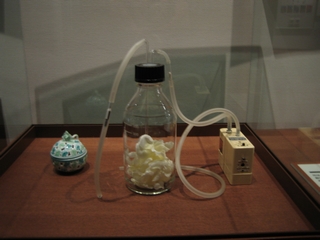
When Roses Won't Do, E-mail a Frangrance With NTT

Tuesday, April 08, 2008 12:10 AM PDT
After satisfying the senses of sight and sound through video streams and music downloads, NTT Communications aims to tap into the sense of smell with a new system that allows users to send fragrances from their cell phones.

A trial of the service will take place later this month during which users will be able to select and send certain fragrance recipes to an in-home unit that is responsible for concocting and releasing the various fragrances. Each holds 16 cartridges of base fragrances or essences that are mixed to produce the various scents in a similar way that a printer mixes inks to produce other colors.

Transforming the mood of room with a new scent is quite easy with this technology.

The first step is to choose a scent from the multitude of fragrance recipes available through an I-mode site on a cell phone. Once chosen the instructions on how to make the scent are then transmitted to the fragrance device through infrared from the phone, and from there the scent is quickly mixed and emitted.

If distance is an issue, the other option is to send the instructions to the device via an e-mail message. The message is intercepted by a home gateway unit that is latched to the home's broadband connection and sends the instructions to the fragrance device at home. Using this method users can set the time and date of fragrance emission, so one can come home to the relaxing scent of lavender, for example.

There's even room for creating customized scents, which can be shared with other users through the fragrance "playlist" on the Web site.

The technology is not only limited to creating a pleasant-smelling workplace or home. NTT also sees it as a way to enhance multimedia content. For example, instead of just sending an image of a bouquet of roses to a friend, one can boost the experience by sending the fragrance as well.

NTT hopes the fragrance emitter will cost about ¥20,000 (US$195) when eventually launched commercially. Cartridge refills should cost about ¥1,600 it said.

NTT Communications believes that fragrance is the next important medium for telecommunications, as more value is placed on high sensory information. Through a company sponsored Internet survey, NTT found that 56 percent of people polled use aromatherapy or believe that it has positive benefits.

"Aromatherapy can reduce stress and help you relax, and to be able to control smell implies one has the power to manipulate feelings as well," said Akira Sakaino, from NTT Communications' Net Business Division.

NTT has been developing this technology, which it calls "kaori tsushin," since 2004, and has collaborated with various outfits to test the service.

Applications have ranged from fragrance rooms in hotels in Tokyo and Osaka to aroma advertising through digital signage, where fragrances were made to match audio-visual content, located in pubs, parking lots and railway stations around Tokyo.

The fragrance communication mobile service test will take place from April 10 to 20 and involves 20 monitors who are tasked to give feedback on the service.
Impossible smells exhibition opens


The world's first exhibition of 'extinct and impossible' smells is under way, from the metallic fallout of the first atomic bomb to the aroma of cloves and oranges from first aid kit of a medieval plague doctor.

Blast-off by Russia spells end for Mir
Fake snot improves electronic nose
Secret of exam success? Rosy memories
The acrid reek of a blazing meteor impact, the sweaty bouquet of a space station, the hothouse aroma of a Victorian greenhouse are also there for the smelling at the Reg Vardy Gallery, University of Sunderland.

One of the smells at the exhibition is the 'surface of the sun'
The aromatic exhibition has drawn on the efforts of perfumers, chemists, botanists and a Nasa scientist. "What we have created here is a world first, a scientific flight of fancy made up of exotic and strange scents," says Robert Blackson of the University of Sunderland, mastermind behind the endeavour.

"One person will love a smell when their friend will hate it," says Blackson. "There are no good or bad smells."

One extraordinary fragrance is the aftermath of the first atomic bomb, dropped on Japan on August 6, 1945. "The Hiroshima smell is quick and pungent, very metallic," says Blackson.

There is also the smell of Cleopatra's hair, based on an incense that was popular among ancient Egyptians containing raisins, an evergreen called Cassia, and wine.

The Soviet Mir space station, which burnt up in the atmosphere in 2001, smells of formaldehyde, charred material (the space station caught fire) and a strong pong of astronaut BO.

Among the stranger smells is the "surface of the sun."

"It is hard to sum up. It is an atmospheric smell, like walking into a room when the sun has been pouring in," says Blackson. "It gives a freshness, a sun kissed feel with a bit of metal. If you can say something smells hot, this is it."

"There's also some extinct flowers," adds Blackson. "Some have been gone for hundreds of years, whilst others have only been extinct for the last 30, due to things like deforestation."

These scents were devised by James Wong, a botanist at Botanic Gardens Conservation International. "Resurrecting the scent of an extinct plant may seem like something straight out of 'Jurassic Park', but the dynamics of the operation are relatively simple, " he says.

"Our team of botanists trawled through an extensive list of extinct flowers and plants to identify entries that were closely related to existing scented species. Then combining historical reports of how these extinct plants smelt, with the fragrance of their living relatives, we can hazard an extremely good guess at what their aroma was like."

"For example, when you see a very close relative of Sandalwood on the list it is very likely that this would have had a strong sandalwood-like odour." And, indeed, the extinct Juan Fernandez Sandalwood from Chile was a popular incense about the turn of the 20th century said to smell like the common Indian Sandalwood, only a little sweeter.

An 'extinct bouquet' of plants includes the Chilean Sandalwood tree, which was driven to extinction in 1908 due to over exploitation of its fragrant wood, and the grassy, herbal smell of Ilex gardneriana holly that has been wiped out since 1997.

Smell is an extremely evocative sense. Perhaps the best known fictional example of its power is in Proust's autobiographical novel, A La Recherche du Temps Perdu. The key scene in the French masterpiece describes how the taste and smell of a madeleine - a tea cake - dipped in the tea enabled the narrator to conjure up memories of his childhood in Combray, where he had first been given the treat by his aunt.

The exhibition runs until Friday June 6 2008.